Gorsuch by John Greenya
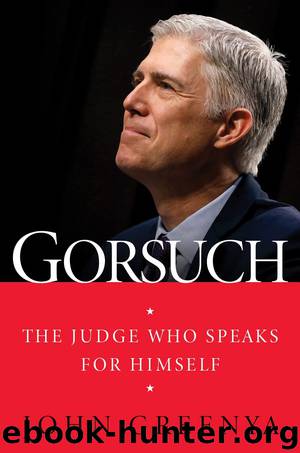
Author:John Greenya [Greenya, John]
Language: eng
Format: epub
Publisher: Threshold Editions
Published: 0101-01-01T00:00:00+00:00
AS BACKGROUND FOR THE nomination hearings, the Senate Judiciary Committee sent Neil Gorsuch a lengthy questionnaire that asked for his education, employment, and publication history, plus a list of the “ten most significant cases” he had heard during his decade as an appellate court judge. Gorsuch’s answers to the questionnaire ran to sixty-eight pages, and revealed that he had decided 3,000 cases (1,800 criminal and 1,200 civil) while on judicial panels of usually three judges, but sometimes more, an impressively high number.
In Yellowbear v. Lampert, decided in 2014, Andrew Yellowbear, an Arapaho Indian in prison for murder, wanted to use the prison’s sweat lodge, and when the prison officials refused, he brought suit, claiming this violated his right to exercise his religious faith. As People for the American Way, a liberal group, reported, “This was not a difficult case, one that was made even easier by the fact that a ruling for Yellowbear would have no impact whatsoever on anyone else’s rights. So it is no surprise that judges nominated by three different presidents (Reagan, Bush 43, and Obama) were in agreement . . . . Yellowbear was a straightforward case that Gorsuch ruled correctly on. He and his colleagues were smart enough to know that ‘due deference’ doesn’t mean ‘blind acceptance.’ ”
Hobby Lobby v. Sibelius, a 2013 case, was one of the most talkedabout cases during the Judiciary Committee members’ questioning of Gorsuch. In this case, the Greens, the family that owned Mardel, a crafts and Christian bookstore chain, sued the Department of Health and Human Services, claiming that their faith would not allow them to follow the provision of the Affordable Care Act requiring them to provide their employees with health insurance that covered contraceptive devices. They sought an injunction to halt the fines triggered by the noncompliance, and when they lost, they appealed the decision. The question became whether a corporation had this right, and the court claimed a corporation did have that right. Gorsuch, who voted with the majority (but did not write the opinion), noted in a concurrence, as qz.com reported, “that the family’s views were reprehensible to some and that religious freedom laws are especially designed to protect unpopular positions.”
Download
This site does not store any files on its server. We only index and link to content provided by other sites. Please contact the content providers to delete copyright contents if any and email us, we'll remove relevant links or contents immediately.
Waking Up in Heaven: A True Story of Brokenness, Heaven, and Life Again by McVea Crystal & Tresniowski Alex(37781)
Empire of the Sikhs by Patwant Singh(23069)
We're Going to Need More Wine by Gabrielle Union(19032)
Hans Sturm: A Soldier's Odyssey on the Eastern Front by Gordon Williamson(18564)
Leonardo da Vinci by Walter Isaacson(13306)
The Radium Girls by Kate Moore(12012)
Tools of Titans by Timothy Ferriss(8360)
Educated by Tara Westover(8043)
How to Be a Bawse: A Guide to Conquering Life by Lilly Singh(7464)
Permanent Record by Edward Snowden(5828)
The Last Black Unicorn by Tiffany Haddish(5626)
The Rise and Fall of Senator Joe McCarthy by James Cross Giblin(5269)
Promise Me, Dad by Joe Biden(5139)
The Wind in My Hair by Masih Alinejad(5085)
A Higher Loyalty: Truth, Lies, and Leadership by James Comey(4946)
The Crown by Robert Lacey(4802)
The Iron Duke by The Iron Duke(4346)
Joan of Arc by Mary Gordon(4092)
Stalin by Stephen Kotkin(3955)
